

What if AI could handle some of the most resource-intensive work in defence capability planning? That was the challenge the British Army sought to solve using D3IP's Innovation as a Service model and collaboration network.
What is Force Centric Capability Management?
Force Centric Capability Management (FCCM) is the process by which the British Army maintains a coherent picture of its force elements, their capabilities, and their readiness through a structured set of documents, templates, and outputs.
Producing and maintaining this material by traditional means is resource-intensive and increasingly difficult to sustain. Early candidate artefact types earmarked for potential automation included:
- Force structure templates
- Capability demand matrices
- Operational output descriptors
The Army wanted to determine whether AI and machine learning could ease that burden without compromising security, traceability, or operational relevance.
Three Questions the FCCM Initiative Set Out to Answer
Can AI and machine learning generate FCCM artefacts with defensible traceability to source documentation?
Can this be done within MOD-appropriate secure environments, and within clear IP arrangements?
What does a credible path from proof of concept to operational service actually look like?
A Collaboration Between the Army and Industry
The Discovery phase was designed to surface novel insights from the industry respresentatives (prodominantly SMEs) within the D3IP Community and give the Army a first-hand view of the options available before looking to piloting a proof of concept.
Phase One — Challenge Statement & Industry Response
D3IP issued a detailed challenge statement supported by a live briefing and webinar Q&A, giving all participants a consistent understanding of the problem. Industry was invited to respond, assessed against five criteria: alignment with FCCM objectives, technical and security feasibility, usability, evidence of capability, and commercial considerations.
13 expressions of interest were received from industry. The security question — particularly aggregation risk and where classification boundaries should sit — emerged early as a key theme.
Phase Two — Review, Shortlisting & Presentations
D3IP's technical specialists reviewed all 13 responses before passing them to the Army stakeholder panel. Seven organisations were invited to a presentation day at the Defence BattleLab, Dorset Innovation Park, each given 45 minutes to present their approach, demonstrate existing solutions, and take questions from a combined panel of 10 Army representatives, including colleagues from the Army AI Centre.
Following the presentations and a stakeholder discussion, two participants were selected to proceed to a funded Incubate phase: Hpad, Inc. and Mission Decisions.
Testing the Art of the Possible
Both selected suppliers were commissioned to independently generate the same real FCCM artefact — a Level 1 Concept of Operations (CONOPS) — end to end, with defensible traceability back to source documentation, within a bounded proof of concept window. Each used a distinct architectural approach.
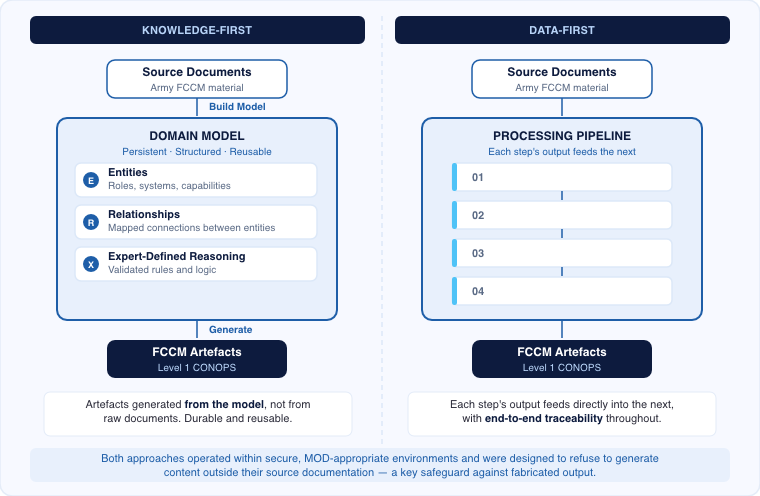
Approach A — Knowledge-First
Building a structured, persistent model of the domain first — entities, relationships, and expert-defined reasoning — then generating artefacts from that model rather than directly from raw documents. Well suited to durable, reusable knowledge infrastructure.
Approach B — Data-First
Chaining a sequence of automated processing steps directly from source documents through to structured, traceable outputs, with each step's output feeding the next. Well suited to fast, automated generation at scale.
Both suppliers operated within secure, MOD-appropriate environments, and both systems were explicitly designed to refuse to generate content outside their source documentation — a key safeguard against fabricated output.
What the Incubate Phase Revealed
Both suppliers successfully generated an indicative Level 1 CONOPS with end-to-end traceability from source documentation through to structured output. Here is what they found along the way.
The real constraint is source documentation quality, not the AI. Both suppliers independently identified inconsistent terminology, incomplete examples, and inaccessible documents as the primary barriers to output quality. Investment in improving source documentation would have a directly proportionate effect on AI output quality.
The two approaches are complementary, not competing. The knowledge-first approach builds durable, reusable knowledge infrastructure; the data-first approach enables fast, automated generation at scale. A combined approach was identified as the strongest path forward.
Subject matter expert input is the critical path. Without embedded defence expertise reviewing and calibrating outputs, results risk being coherent and traceable, but incorrect in operationally significant ways. SME involvement is not optional.
There is value beyond the artefact itself. Both approaches surfaced terminology inconsistencies, information gaps, and conflicting policy direction across source material faster and more comprehensively than manual review could. This secondary benefit emerged as significant in its own right.
Security and IP arrangements are workable. Both suppliers demonstrated they could operate within MOD-appropriate secure environments with clear intellectual property arrangements, reducing a common barrier to further adoption of AI-enabled tools in Defence.
A Model Built for This Kind of Problem
The FCCM Initiative demonstrates how D3IP's Innovation as a Service model works in practice, moving at pace from a complex challenge to working prototypes, without the cost and lead time of traditional procurement.
For SMEs and specialist organisations often put off by the complexity of traditional procurement, D3IP's pre-procured environment removes those barriers, giving you a clear, low-friction route to engaging with Defence challenges and showcasing your capabilities.
Delivered in Partnership With
Get Involved in Future Initiatives
The FCCM Initiative is one example of how D3IP is helping Defence explore the art of the possible with AI. Future initiatives are your opportunity to engage directly with Defence challenges and showcase your capabilities.
Discover more from D3IP…
Assured C2: Building Communications That Survive The Fight
When jamming, cyber-attack, and area-denial can sever a signal in an instant, ensuring you have command and control (C2) capabilities that can survive the fight is essential. But that doesn’t boil down to developing one clever technology – rather than a silver bullet, you need a resilient and adaptable ecosystem.

The Defence Investment Plan is Here: What it Means for SMEs
The long-awaited Defence Investment Plan (DIP) was published last week, setting out how the Ministry of Defence will allocate £298 billion of investment over the next four years, including £15 billion of additional spending on top of last year’s Spending Review.
Register Your Interest in the D3IP Community
© 2025 D3IP | D3IP is a brand of DII Ltd.
Resources
© 2025 D3IP | D3IP is a brand of DII Ltd.
Proudly Supporting