
What if Defence could run experiments, train AI models, and test new systems, all without ever touching classified or personally identifiable data? That's the promise of synthetic data, and what D3IP was tasked with exploring through the Defence BattleLab and in partnership with the D3IP Community.
This initiative brought together Defence stakeholders and our network of expert contributors from across industry and academia to understand how synthetic data could be safely and efficiently used to support trials, testing, and innovation. Here's what we found.
Synthetic data is artificially generated information that mimics the structure and statistical properties of real data, without containing any of the actual real-world information. In Defence, where access to operational data is often restricted due to sensitivity, synthetic data offers a powerful alternative that enables experimentation, model training, and system development without exposing real individuals or classified information.
Faster Innovation Without the Security Risk
For the UK Ministry of Defence (MOD), the ability to use synthetic data could mean faster innovation, safer collaboration, and more agile decision-making. But getting there requires a clear understanding of which methods work, what conditions need to be in place, and how to validate that synthetic data is actually fit for purpose.
The Discovery phase (learn more about the Innovation as a Service phases) set out to answer three key questions:
What are the most promising methods for generating synthetic data?
What conditions need to be in place to use synthetic data effectively in Defence?
How can we test and validate synthetic data to ensure it is fit for purpose?
To answer them, the team reviewed leading research, gathered insights from industry experts, and facilitated collaborative workshops with Defence stakeholders and contributors from the D3IP Community.
What We Discovered
1. Two AI techniques lead the way
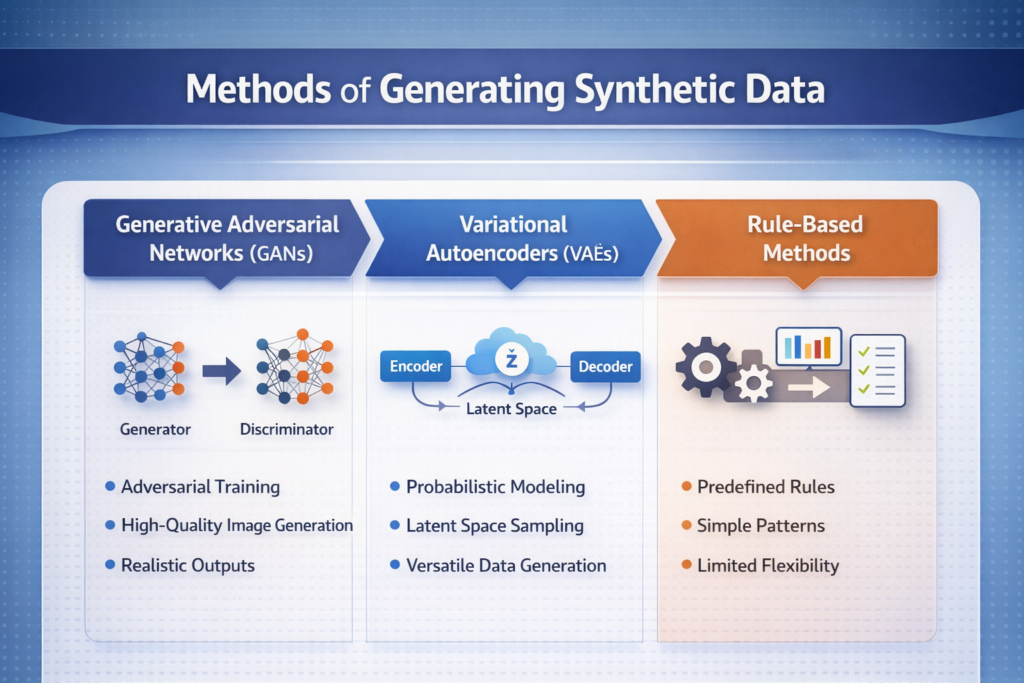
Generative Adversarial Networks (GANs) and Variational Autoencoders (VAEs) are among the most promising techniques for generating high-fidelity synthetic data. These machine learning models can produce realistic data while preserving privacy.
| Technique | Best suited for | Key strength |
|---|---|---|
| Generative Adversarial Networks (GANs) | High-fidelity data generation | High realism |
| Variational Autoencoders (VAEs) | Privacy-preserving model training | Privacy-safe |
| Statistical & rule-based methods | Speed, transparency, or lower-fidelity needs | Practical & fast |
2. Technology alone isn't enough
Clear use cases are essential. Successful implementation depends on identifying specific, well-defined problems where synthetic data can genuinely add value — not treating it as a blanket solution.
Domain expertise matters. Access to subject-matter experts who understand both the technical and operational context is a critical enabler.
Data governance and secure integration. Robust governance frameworks and the ability to integrate synthetic data securely into existing Defence systems are non-negotiable requirements.
3. Validation is critical
Generating synthetic data is only half the challenge. Ensuring it's reliable enough to actually use is equally important. The initiative identified three core validation approaches:
Statistical comparison
Comparing distributions and statistical properties between synthetic and real data to confirm structural accuracy.
Expert review
Engaging domain specialists to assess whether synthetic data passes the 'real world' test in their field of expertise.
Controlled testing
Running synthetic data through structured experiments to verify accuracy, reliability, and safety in operational-like conditions.
*More detailed findings are available to members of our collaboration community via the D3IP Portal. Learn more and register your interest below.
A Model Built for Collaboration
This initiative is a clear example of how the D3IP model works in practice. Rather than handing Defence a pre-packaged solution, we create a structured environment where challenges are defined collaboratively, the right experts are brought together, and insights are developed through shared research and workshops.
How a D3IP Discovery works
A structured, iterative process that gets to actionable insight fast.
By creating a safe space for collaboration, we enable Defence to tap into the best of UK innovation — while ensuring that contributors' intellectual property is protected and their expertise is valued.
Crucially, this process is designed to be accessible. For SMEs and specialist organisations that are often put off by the complexity and cost of traditional procurement, D3IP's pre-procured environment removes those barriers — giving you a clear, low-friction route to engaging with Defence challenges and showcasing your capabilities.
Delivered in partnership with
Get Involved in Future Initiatives
The Synthetic Data Production Initiative is just one example of how D3IP is helping Defence explore emerging technologies. If you have relevant expertise — whether in AI, data science, or a related field — future initiatives like this one are your opportunity to engage.
Discover more from D3IP…
Update on Mantle’s Intention to Acquire D3IP
Following the market announcement, we wanted to update you on a proposed change in ownership of D3IP. Technology Minerals Plc, which trades as Mantle, has announced its intention to acquire D3IP following agreement on initial terms.

The Defence Investment Plan is Here: What it Means for SMEs
The long-awaited Defence Investment Plan (DIP) was published last week, setting out how the Ministry of Defence will allocate £298 billion of investment over the next four years, including £15 billion of additional spending on top of last year’s Spending Review.
Register Your Interest in the D3IP Community

© 2025 D3IP | D3IP is a brand of DII Ltd.
Resources
© 2025 D3IP | D3IP is a brand of DII Ltd.
Proudly Supporting